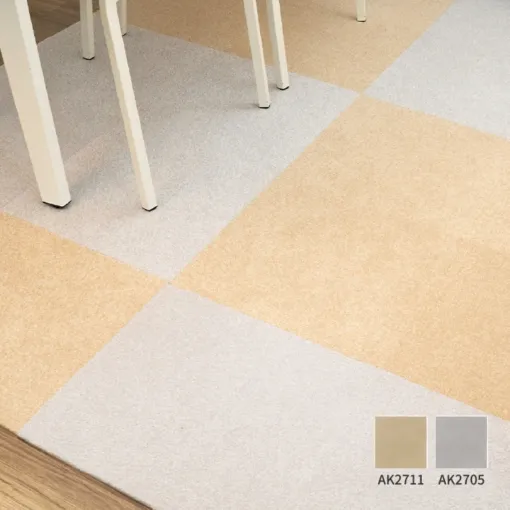
Short answer: modular carpet tiles can be a sensible playroom surface when you want local coverage, individual hand washing, replaceable squares, and a no-glue installation on a compatible finished floor. They are not a substitute for a certified playground impact surface, childproofing, supervision, or a product selected for a known allergy or medical requirement.
Why modular tiles work differently from one large rug
| Playroom need | What modular tiles change | Limit to remember |
|---|---|---|
| Food, paint, or muddy footprints | Lift the affected square instead of moving the entire rug. | TOLI requires hand washing; the tiles are not machine washable. |
| A changing activity zone | Expand, reduce, or move a grid in complete 40 cm modules. | Every new location still needs a compatible, clean, smooth base floor. |
| Rental-friendly placement | Soft Back Q uses suction treatment, so the tile itself does not require adhesive on a suitable finish. | This is not permission to ignore a lease, flooring warranty, or building rule. |
| Worn or damaged area | One square can be replaced while the rest of the layout stays in service. | Keep matching spare color codes because dye lots and future stock can vary. |
| Toy drops and ordinary footsteps | The covered surface can reduce lightweight floor-impact sound. | It does not soundproof voices, heavy jumping, walls, or the apartment above. |
| Falls and active play | Carpet is less hard at the point of contact than an uncovered hard finish. | AK27 and AK35 product pages do not provide a playground fall-height rating or a promise against injury. |
AK27 or AK35 for a children's space?
| Feature | AK27 / Attack 270 | AK35 / Attack 350NE |
|---|---|---|
| Tile size | 40 x 40 cm (15.7 x 15.7 in) | 40 x 40 cm (15.7 x 15.7 in) |
| Total thickness | 9 mm | 9.3 mm |
| Pile | 5 mm cut pile | 3-5 mm multi-level loop pile |
| Surface fiber | BCF nylon | Solution-dyed polypropylene |
| Backing | Soft Back Q suction treatment | Soft Back Q suction treatment |
| Household treatments shown by TOLI | Stain-resistant and deodorizing | No stain-resistant or deodorizing mark on the current page |
| Lightweight floor-impact class | ΔLL(I)-3 | ΔLL(I)-4 |
| Practical starting point | Snack, craft, pet, and brighter color zones | Calmer neutral zones where the higher published impact class leads |
For most spill-prone family rooms, AK27 is the more practical first comparison because its current page shows cut pile, stain-resistant treatment, deodorizing treatment, and 14 solid colors. AK35 makes sense when a quieter neutral palette and its higher lightweight floor-impact class matter more. Both pages display hand-washable, anti-mite, low-shedding, floor-heating-compatible, fire-retardant, F☆☆☆☆, Good Design Award, and Kids Design Award marks.
An award mark is not a child-safety certification. It does not replace edge checks, supervision, age-appropriate furniture, anchored storage, outlet protection, or a tested impact-attenuating mat where one is required. Read the guide to TOLI product marks before turning a label into a claim it does not make.
“Washable” means one tile at a time, by hand
TOLI's current Q&A says Fabric Floor tiles can be hand washed, and its manual explicitly prohibits washing machines, spin cycles, and dryers. For a fresh spill, remove solids or blot liquid promptly. If the square needs deeper care, use water first, then a diluted neutral detergent if needed, rinse away residue, remove excess water with towels, and shade-dry it flat or standing as straight as possible.
Do not reinstall a damp tile. TOLI warns that incomplete rinsing can reduce suction performance, while stored or installed moisture can contribute to deformation, discoloration, pile damage, or mold. One or two matching spare tiles keep the zone usable while a washed square dries.
- Vacuum the activity zone routinely.TOLI's manual suggests careful vacuuming twice a week as a general benchmark, with more attention where children eat or sit.
- Blot, do not spread.Work from the edge of a fresh mark toward the center and avoid aggressive pile scrubbing.
- Lift only the affected tile.Mark its direction before removal so it returns with the pile aligned.
- Rinse thoroughly.Detergent residue can affect the backing and may attract new soil.
- Shade-dry completely.Do not use a tumble dryer or reinstall the tile while moisture remains.
Three exact playroom layouts using complete tiles
Measure the real movement area, not just the empty rectangle in the room. Include floor sitting, block building, reading, toy storage access, and the route a child takes into the zone. Keep door swings, floor vents, stairs, and furniture that must sit level outside the rug edge.
1. Compact reading and building square
4 x 4 / 16 tiles / 160 x 160 cm. About 5 ft 3 in square, useful for one focused floor-play corner.
Open the 16-tile layout2. Shared living-room play zone
4 x 6 / 24 tiles / 160 x 240 cm. About 5 ft 3 in x 7 ft 10 in, long enough for shared play beside a sofa.
Open the 24-tile layout3. Larger family activity rectangle
5 x 7 / 35 tiles / 200 x 280 cm. About 6 ft 7 in x 9 ft 2 in, with room for multiple activity stations.
Open the 35-tile layoutThese dimensions describe product quantity, not a safety rating. Tape the outline on the floor for a day before ordering. Watch whether knees, hands, toys, and feet repeatedly land outside the planned edge, and whether bins can open without catching a corner.
Check the base floor and every exposed edge
TOLI lists finished wood flooring, vinyl tile or sheet, cushion floor, marble, and ceramic tile among compatible examples. It lists existing carpet, tatami, mortar, and concrete as unsuitable for the suction-backed placement. Some wood finishes may grip poorly, so TOLI recommends a sample test.
- Clean and dry the floor first.Dust and debris reduce contact between the suction backing and finished floor.
- Place complete rows.A regular rectangle is easier to inspect than isolated squares or narrow projections.
- Press every tile and seam.Do not allow pile to fold beneath an edge, and correct any raised corner before the room is used.
- Inspect after energetic play and cleaning.Re-seat a moved tile and remove the zone from use if an edge will not lie flat.
- Keep the floor manufacturer's rules.Check radiant-heating, finish, discoloration, and covering restrictions before long-term placement.
What these carpet tiles do not replace
A modular rug does not anchor bookcases, pad sharp furniture, guard stairs, cover electrical outlets, separate small parts by age, or create a certified fall zone beneath climbing equipment. It also does not make a room allergen-free, waterproof, stain-proof, or maintenance-free. Treat flooring as one layer in the room plan, then address furniture, storage, supervision, and the child's needs separately.
Buying decision: choose AK27 first for a colorful, spill-prone play zone where cut pile and stain and odor treatments are useful. Compare AK35 when its neutral palette and higher published lightweight impact class better fit the room. In either case, test the base floor, plan complete modules, keep spare color codes, and describe the product as hand-washable rather than machine washable.