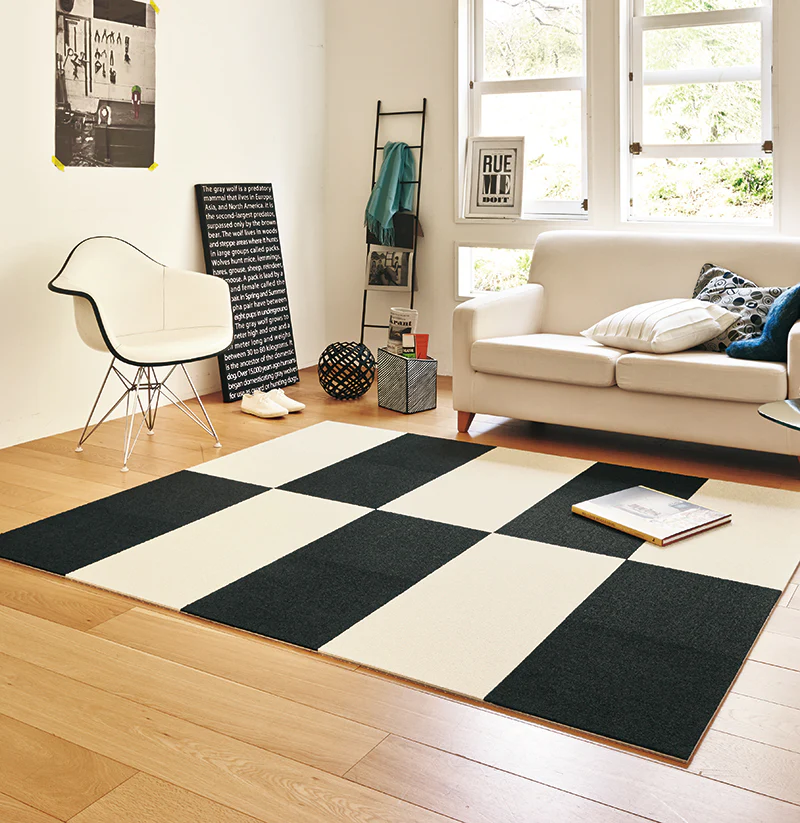
Short answer: both AK27 and AK35 are listed by TOLI as pet-compatible and hand-washable. Choose AK27 first for cats, dogs with prominent claws, feeding areas, or odor-prone spaces. Choose AK35 when you prefer its warm loop texture and quiet neutral palette and claw catching is less of a concern.
AK27 vs AK35 for a home with dogs or cats
TOLI's official Fabric Floor Q&A says the full range is pet-compatible, then adds an important qualification: cats and some small dogs with dewclaws may catch a claw in loop pile, so TOLI recommends a cut-pile product for those animals. That makes pile construction the first decision, not color.
| Pet-household question | AK27 Canvas Fine | AK35 Ripple Palette Neo |
|---|---|---|
| Pile | 5 mm cut pile | 3-5 mm multi-level loop pile |
| Fiber | 100% BCF nylon | 100% solution-dyed polypropylene |
| Claw-catching concern | Lower; TOLI specifically points pet owners toward cut pile | More care needed with cats and dogs whose claws catch loops |
| Listed pet-use treatments | Stain-resistant and deodorizing | Those two treatments are not listed |
| Cleaning | Remove and hand-wash | Remove and hand-wash |
| Best starting use | Pet beds, feeding zones, active routes, frequent mess | Calmer lounge zones and neutral rug layouts |
AK27 is not “pet-proof,” and AK35 is not unsuitable for pets. The useful conclusion is narrower: AK27 carries more pet-specific features, while AK35 trades those features for a distinctive loop texture and a 16-color home palette.
Why modular carpet can be easier than one large rug
A large rug turns one muddy paw print into a whole-rug cleaning job. With Fabric Floor, each tile has a suction-treated backing and is installed without adhesive on a compatible clean, smooth floor. You can lift the marked square, keep the rest of the layout in place, and put a spare tile into the gap while the washed piece dries.
That is also useful when wear is concentrated. Dogs often follow the same route from a doorway to a sofa, bed, or food station. A modular layout lets you cover that route or build a smaller rug around it instead of carpeting the entire room.
Plan the pet zone before choosing a color
1. Measure the actual route
Measure the finished soft area, not the wall-to-wall room dimensions. Each AK27 and AK35 tile is 40 x 40 cm, about 15.7 x 15.7 inches. Our design tool rounds the length and width up to complete tiles and shows the exact count.
2. Put practical colors where mess happens
Use mid-tone or mixed colors near the entry, food bowl, pet bed, or favorite window. Lighter tiles can sit farther from the highest-use route. A checker or random layout can also make one replacement less visually obvious than a large solid field.
3. Keep real spare pieces
TOLI recommends keeping a few spares so the floor can stay covered during washing. Our practical starting rule is two spare tiles for a 10-20 tile rug and three or four for a larger rug, a puppy, or a frequently wet entry. Spares should match the exact model and color code.
4. Check the floor underneath
Fabric Floor is intended for compatible hard floors such as many wood and resilient floor surfaces. TOLI does not recommend placing it over existing carpet or tatami, and floor-heating manufacturers may restrict rugs. Clean away dust before installation so the backing can grip properly.
How to clean a pet mess without damaging the tile
For routine care, TOLI's care manual recommends slow, thorough vacuuming at least twice a week, with extra attention where people and pets spend time. For a localized spill, remove the affected square and start with water. If water is not enough, use a small amount of diluted neutral detergent and a soft sponge or brush.
- Rinse until detergent is fully removed; residue can reduce the backing's grip.
- Shake off water gently, then absorb more with a towel.
- Shade-dry in a ventilated place, lying flat or standing as straight as possible.
- Reinstall only after the tile and backing are completely dry.
- Do not machine wash, spin dry, tumble dry, or dry clean the tile.
See the full hand-washing guide for the short removal sequence, or use the complete carpet tile care schedule for vacuuming, spills, monthly wiping, washing, and drying.
Pet-friendly is not the same as allergy-friendly
Important for allergy and asthma households: “pet-compatible” describes product use; it is not a medical or allergen-control claim. The U.S. EPA identifies pet dander and other biological particles as potential asthma triggers and recommends regular cleaning. A removable carpet tile can make localized maintenance easier, but it does not remove allergens by itself.
The EPA advises vacuuming carpets and fabric-covered furniture every week or more often and suggests considering a HEPA-filter vacuum to reduce dust build-up. Anyone with significant asthma or pet allergy should follow medical guidance and may need to keep pets and soft flooring out of the affected person's bedroom.
Which one should you buy?
Choose AK27 when the rug is primarily for a dog or cat, claw catching is a concern, or you want the listed stain-resistant and deodorizing treatments. Its stronger colors also make practical borders and mixed layouts easy.
Choose AK35 when the room look comes first, you prefer its warmer loop surface and subdued Japanese home palette, and your pet is unlikely to pull loops. Keep a few spare tiles and use the same hand-washing routine.
Start with the route your pet actually uses, test it in the design tool, and request an invoice only after the tile count, colors, and spare quantity look right.