.webp)
Can carpet tiles make an area rug? Yes. Keep the tiles as a defined island under furniture, then use color placement to give the outside edge a deliberate finish.
How to make carpet tiles look like a rug
A tile layout looks like an area rug when its boundary is planned as clearly as its pattern. Start with a complete rectangle, align the long edge with the sofa, bed, or desk, and leave enough hard floor visible around it to read as a separate textile zone. A random group of squares can look temporary; one deliberate footprint looks furnished.
- Use a solid field for the quietest, most seamless result.
- Add a one-tile border when you want the outside edge to feel finished.
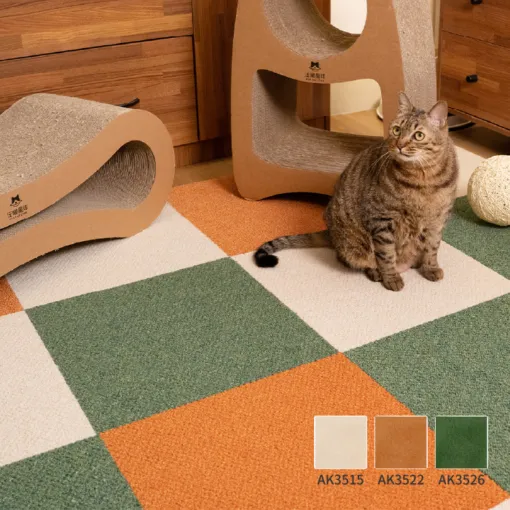
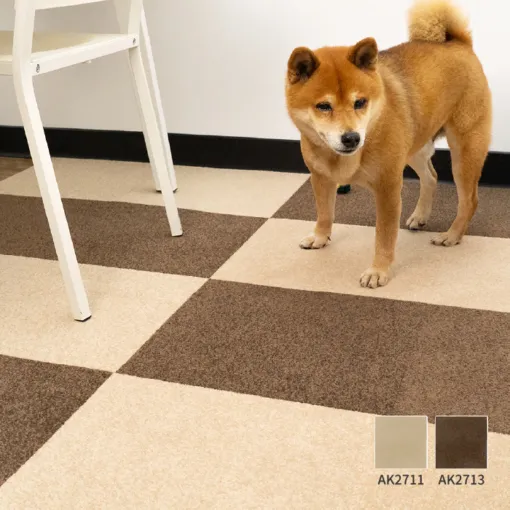
- Choose two neighboring tones for a checker that reveals the grid without dominating the room.
- Keep edges out of door swings and walking routes because a tile rug still has a raised perimeter.
For a softer Japanese-style room, see the warm Japanese interior carpet tile guide. When the pattern is clear but the colors are not, compare six exact small-room AK35 and AK27 palettes with ready-made designer links.
Four carpet tile rug patterns to copy
Soft checker
Use two nearby colors for a quiet living-room rug. A 3 x 4 checker uses 12 tiles and measures 120 x 160 cm.
Open this 12-tile designFinished border
A darker edge frames a desk or sofa zone. This 4 x 5 layout uses 20 tiles and measures 160 x 200 cm.
Open this 20-tile designStripe runner
A 2 x 5 runner uses 10 tiles and measures 80 x 200 cm, a useful shape beside a bed or through a narrow room.
Open this 10-tile runnerColor-block zone
Use four-tile blocks to define a family corner. A 4 x 4 square uses 16 tiles and measures 160 x 160 cm.
Open this 16-tile designChoose a tile rug pattern by room, not by trend
A pattern should solve the visual problem in front of it. In a living room with several furniture finishes, a solid field or low-contrast checker gives the sofa group one calm base. In a plain bedroom, a narrow stripe or two-tone runner can add direction without filling the whole floor. Under a desk, a border can make the zone easy to read, but its raised outside edge must stay out of a chair's normal wheel path.
View the layout from the doorway before approving it. The first visible edge usually matters more than the pattern hidden under furniture. Keep a full row along that edge, avoid placing a raised corner in the main walking line, and check that a door can open without touching the pile.
Color distribution also changes maintenance. Mid-tone tiles are forgiving beside a sofa or desk; pale tiles can sit farther from shoes, pet bowls, and chair wheels. Keep one or two spare pieces from the same order so a washed tile can dry without leaving a gap and a worn square can be replaced later.
Common rug sizes and exact tile counts
Need help choosing the footprint before the pattern? Use the sofa, bed, and desk rug size guide to measure the furniture zone and tape-test complete 40 cm rows. For a desk chair, first read the home-office caster and load guide; AK35 and AK27 are residential tiles and are not presented by TOLI as caster-rated products.
| Tile layout | Tiles | Metric size | Imperial size | Useful for |
|---|---|---|---|---|
| 2 x 3 | 6 | 80 x 120 cm | 31.5 x 47.2 in | Reading chair or small desk |
| 3 x 4 | 12 | 120 x 160 cm | 47.2 x 63 in | Bedside or compact sofa |
| 4 x 5 | 20 | 160 x 200 cm | 63 x 78.7 in | Living-room rug zone |
| 5 x 6 | 30 | 200 x 240 cm | 78.7 x 94.5 in | Larger sofa grouping |
Turn the idea into a design and quote
The free design tool calculates the quantity from your chosen width and depth, lets you paint individual tiles, and sends the color breakdown into the PayPal invoice form. Add one or two spare tiles when the rug will sit near food, pets, or an office chair.