.webp)
Short answer: use one quiet base color, or two closely related colors, and build a complete rectangle that follows the furniture. Leave some hard floor visible. The carpet should make the room feel calmer and warmer, not busier.
What makes a carpet layout feel Japanese?
There is no single formula for a Japanese interior, and "Japandi" is a modern international label rather than a TOLI product category. Still, many successful rooms share a few practical ideas: natural materials, low visual contrast, furniture with a clear purpose, daylight, and enough open floor to let each object breathe.
A carpet tile rug can support those ideas because its size is controlled in small modules. It can stop at the edge of a bed, sit beneath the front legs of a sofa, or define a reading corner without covering the entire wood floor. TOLI itself presents Fabric Floor as a flexible system that can be arranged as a partial rug or installed across a larger compatible floor.
1. Start with a restrained palette
Choose the floor colors after looking at the room's largest fixed surfaces: wood tone, wall color, sofa, curtains, and cabinetry. For a quiet room, use one carpet color that sits between the lightest and darkest of those elements. If you want a pattern, add one neighboring tone rather than a high-contrast opposite.
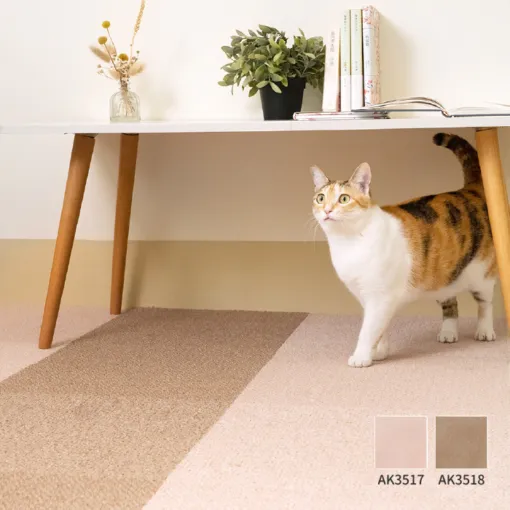
TOLI AK35 has 16 colors and a multi-level loop surface. Its stone, ivory, linen, soil, walnut, rice, and almond-like tones make it the natural first stop for a warm minimalist room. TOLI describes the collection as a refined palette designed to sit comfortably in many interiors. AK27 has 14 solid colors and a 5 mm cut pile, so it works when you want a cleaner field or a small accent in green, blue, peach, or carrot.
.webp)
2. Treat the carpet tiles as a rug, not wall-to-wall decoration
Visible hard floor gives a small room breathing room and makes a modular rug look intentional. Build the smallest complete footprint that connects the important furniture. Under a sofa, place the front legs on the rug where practical. Beside a bed, follow the area where feet land. At a desk, cover the chair movement zone without putting a raised edge directly in the main walking path.
| Layout | Tiles | Finished size | Good starting use |
|---|---|---|---|
| 3 x 4 | 12 | 120 x 160 cm / 47.2 x 63 in | Bedside, reading chair, compact sofa |
| 4 x 5 | 20 | 160 x 200 cm / 63 x 78.7 in | Small living room or home office |
| 5 x 6 | 30 | 200 x 240 cm / 78.7 x 94.5 in | Larger sofa or family zone |
These are planning examples, not universal furniture rules. Tape the outline on the floor first and walk around it. Door clearance, chair movement, vents, and trip routes matter more than matching a standard rug chart.
3. Make the tile grid deliberate
Seams are part of a modular carpet, so trying to disguise every join can make the result feel accidental. A single-color field is the calmest option. A soft checker with two related colors gives subtle movement. A one-tile border frames the rug, while a narrow stripe can connect a long bed or desk to the room.
Keep the outside rectangle complete whenever possible. Align its long edge with the main furniture or wall, and avoid a final row that appears stranded. The carpet tile rug pattern guide includes checker, border, runner, and color-block examples; the free design tool lets you test those ideas with exact AK35 and AK27 colors.
4. Choose AK35 or AK27 by how the room is used
Choose AK35 when the priority is a soft neutral palette and a warm loop-pile expression. Its current specification is a 40 x 40 cm solution-dyed polypropylene tile with a 3-5 mm multi-level loop pile and suction-treated backing.
Choose AK27 when a pet household, stronger accent, or cut-pile surface matters more. Its current specification is a 40 x 40 cm BCF nylon tile with a 5 mm cut pile. TOLI lists stain-resistant and deodorizing treatments, and describes the cut pile as less likely to catch pet claws.
Both collections are designed to be placed without glue on compatible floors, lifted, and hand-washed one tile at a time. Neither collection is machine washable. Keep several spare tiles from the same order for drying time, concentrated wear, or future replacement.
5. Do not place Fabric Floor over tatami
A Japanese-looking room is not the same thing as a tatami room. TOLI's official Q&A lists tatami and existing carpet as unsuitable bases for Fabric Floor. Mortar and concrete are also listed as unsuitable. Compatible examples include many wood floors, vinyl tile or sheet, cushion flooring, marble, and ceramic tile, but TOLI recommends sample-testing some wood finishes because grip can vary.
Check the actual base floor before ordering. Clean away dust before placement, test an inconspicuous area, follow the floor manufacturer's care instructions, and keep raised rug edges away from stairs, doors, and busy walking routes.
A simple room recipe
For a bright bedroom, try a 3 x 4 or 4 x 5 AK35 rectangle in one pale neutral, positioned beside or partly beneath the bed. For a darker wood living room, use two close gray or earth tones in a soft checker. For a family or pet corner, begin with an AK27 neutral field and reserve one accent color for a border or two-tile block.
The test is simple: when you enter the room, the carpet should support the light, wood, and furniture rather than announce itself first. Build the footprint in the designer, check the real dimensions with tape, then request an invoice only after the layout feels settled.