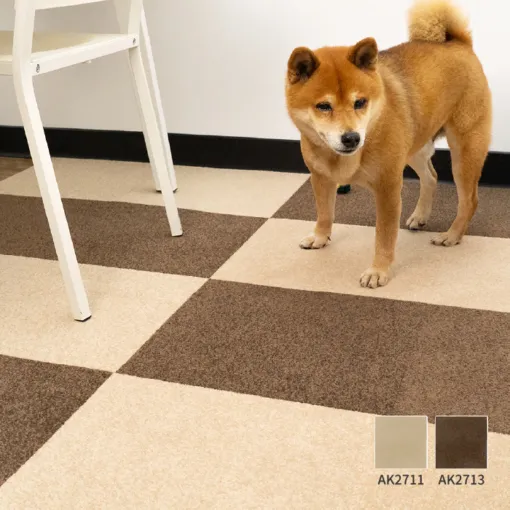
Short answer: AK27 or AK35 can make a soft, removable landing on a compatible finished floor inside a residential entryway. Put a purpose-built scraper mat before it and a waterproof tray under wet footwear. Fabric Floor is hand-washable, but it is not a waterproof drainage surface, an outdoor doormat, or commercial entrance flooring.
Divide the entrance into wet and dry zones
The word entryway covers several jobs. The square immediately outside the door must handle weather. The threshold may receive wet soles and grit. Farther inside, people pause, remove shoes, leash a dog, or enter a hallway. A residential modular rug belongs only where that sequence has already removed most free water and abrasive debris.
| Entrance zone | Main job | Best surface decision |
|---|---|---|
| Outside the door | Scrape coarse dirt and face rain, sun, snow, or ice | Use a weather-rated exterior mat, not AK27 or AK35. |
| First step inside | Catch remaining water, road salt, and mud | Use a purpose-built absorbent walk-off mat over a suitable hard floor; keep wet boots in a waterproof tray. |
| Dry shoe-off landing | Add warmth where shoes come off and paws enter the home | AK27 is the practical first comparison when the finished floor is compatible and normally dry. |
| Hallway transition | Connect the entry to a living area after footwear is controlled | AK27 or AK35 can work; choose by treatments, texture, sound class, and color. |
Purpose-built commercial entryway systems use surfaces engineered to scrape and manage tracked soil and moisture. That is a different specification from TOLI's residential, removable Fabric Floor. Treat the two as complementary layers rather than interchangeable products.
Why AK27 is the first entryway comparison
| Feature | AK27 / Attack 270 | AK35 / Attack 350NE |
|---|---|---|
| Tile size | 40 x 40 cm (15.7 x 15.7 in) | 40 x 40 cm (15.7 x 15.7 in) |
| Total thickness | 9 mm | 9.3 mm |
| Pile | 5 mm cut pile | 3-5 mm multi-level loop pile |
| Surface fiber | BCF nylon | Solution-dyed polypropylene |
| Backing | Soft Back Q suction treatment | Soft Back Q suction treatment |
| Entry-relevant treatments shown by TOLI | Stain-resistant and deodorizing | No stain-resistant or deodorizing mark on the current page |
| Lightweight floor-impact class | ΔLL(I)-3 | ΔLL(I)-4 |
| Practical starting point | Dry shoe-off zones, pets, tracked marks, and replaceable service tiles | Dry inner hallways where neutral colors and the higher impact class lead |
TOLI's current AK27 page lists 14 colors, BCF nylon cut pile, stain-resistant treatment, deodorizing treatment, and hand washing. Those features make it the sensible first product to compare near a household entrance, but they do not make it waterproof, salt-proof, or designed to scrape mud from boots. AK35 has 16 calm colors and the higher published lightweight floor-impact class; its current page does not display the stain-resistant or deodorizing marks.
A dog returning from outdoors adds the same zoning question. Wipe wet paws on the first mat, then let the removable carpet-tile zone begin on the dry side. For claw-catching risk, TOLI recommends cut pile for cats and some small dogs with dewclaws, another reason AK27 can lead the comparison.
Measure the door before the rug
An entry rug cannot interfere with evacuation, door movement, a threshold, a floor vent, or the place where someone naturally stands. Open the door through its complete arc and measure the smallest clearance beneath it. AK27 is 9 mm thick and AK35 is 9.3 mm, before any optional accessory or unevenness in the floor is considered.
- Trace the full door swing.Keep every tile and raised outside edge clear of the moving door.
- Mark the wet-footwear point.The TOLI layout should begin after the scraper mat and boot tray, not beneath dripping shoes.
- Walk the normal route.Test grocery bags, pets, strollers, shoe storage, and two people passing at once.
- Round to complete 40 cm modules.A full-tile exposed edge is easier to inspect and rearrange than a thin cut strip.
- Check the base floor.TOLI lists many finished wood, vinyl, cushion-floor, marble, and ceramic surfaces as compatible examples, while carpet, tatami, mortar, and concrete are unsuitable for suction placement.
TOLI offers separate edge trim when a product edge or step is a concern. No accessory replaces the need for door clearance and a stable walking route. Test unfamiliar wood finishes with a sample because some may not provide reliable suction.
Three dry-entry layouts using complete tiles
These are interior transition layouts, not exterior mat dimensions. Tape the rectangle on the floor, open every door, place the shoe rack and boot tray, and walk the route before ordering.
1. Narrow shoe-off landing
2 x 3 / 6 tiles / 80 x 120 cm. About 2 ft 7 in x 3 ft 11 in. Use only when the entire rectangle clears the door and begins on the dry side of the entrance.
Open the 6-tile layout2. Family changeover zone
3 x 4 / 12 tiles / 120 x 160 cm. About 3 ft 11 in x 5 ft 3 in. The border makes high-contact outside tiles easy to identify for rotation or washing.
Open the 12-tile layout3. Long hallway transition
3 x 5 / 15 tiles / 120 x 200 cm. About 3 ft 11 in x 6 ft 7 in. This extends warmth toward the living area while keeping the wet boot station separate.
Open the 15-tile layoutClean grit before it becomes wear
TOLI's care manual makes routine vacuuming the foundation of Fabric Floor maintenance and gives twice weekly as a general home guideline. An entry transition may need inspection and vacuuming more often because traffic and weather vary. Lift loose grit instead of walking it deeper into the pile, and vacuum against the pile direction slowly enough to reach the base.
If tracked material marks one tile, remove loose solids without spreading them. Use water first; if needed, hand wash gently with diluted neutral detergent, rinse completely, remove excess water with towels, and shade-dry in a ventilated place. TOLI prohibits washing machines, spin cycles, and dryers. A tile must be completely dry before it returns to the floor.
Hand-washable does not mean the installed rug contains water. Moisture can reach the finished floor through seams, so lift adjacent squares and dry the base immediately after a wet incident. TOLI warns that retained moisture can contribute to deformation, discoloration, deterioration, pile damage, or mold, while incomplete rinsing can reduce suction and increase slipping risk.
When a different product is the safer answer
- Outdoor exposure: choose a weather-rated exterior mat.
- Dripping boots, snowmelt, or road salt: use a waterproof tray and a purpose-built interior walk-off surface over a moisture-tolerant floor.
- Repeated commercial foot traffic: specify commercial entryway flooring designed for the traffic and maintenance plan.
- Mortar, concrete, carpet, or tatami base: do not rely on Fabric Floor's suction backing there; TOLI lists those bases as unsuitable.
- Door or threshold conflict: keep the area as hard flooring or choose a lower-profile system that preserves safe clearance.
Buying decision: choose AK27 for a normally dry residential landing after a real dirt-and-water control point. Choose AK35 only when the same dry-use conditions are met and its neutral loop texture or higher lightweight impact class matters more. If the tile will be the first thing a muddy boot touches, choose an actual entrance-matting product instead.