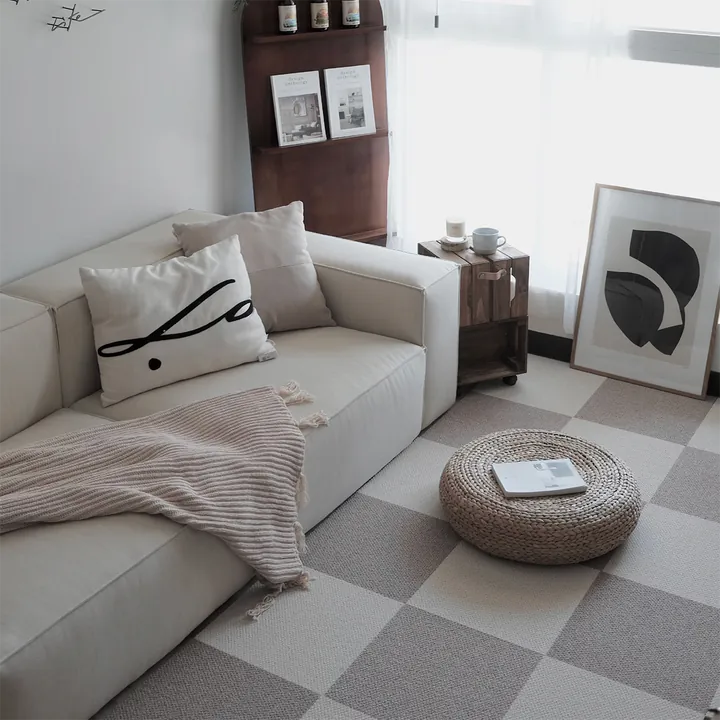
Short answer: measure the sofa's complete width, its front-leg line, the coffee table, and every route around the seating group. Then build the smallest complete 40 cm rectangle that puts the front legs and the table on the same visual field without forcing a raised edge into a doorway or busy walking path.
Choose how the rug connects the furniture
A rug that stops beneath the coffee table can look detached from the sofa. A much larger rug can connect every chair, but it also costs more, hides more serviceable tiles beneath heavy furniture, and may interrupt circulation. Choose the furniture relationship first; choose the pattern second.
| Placement | When it works | What to check |
|---|---|---|
| Coffee-table island | The smallest footprint when no sofa or chair legs need to sit on the rug | Whether it looks disconnected, whether feet reach it, and whether its exposed edge crosses a walking line |
| Front-legs anchor | The best default for a sofa and one coffee table | Actual front-leg depth, rug width beyond the sofa, side-chair feet, and table clearance |
| All furniture on | A large room where every sofa and chair can sit fully inside one field | Rear-leg loads, access to hidden tiles, floor vents, doors, and the cost of low-visibility coverage |
| L-shaped or sectional zone | A chaise, corner sofa, or family seating group with one shared center | Both front-leg runs, the inside corner, everyone's foot area, coffee table, ottoman travel, and both open ends |
IKEA's current living-room rug guidance recommends a rug that extends beyond a sofa on both sides and says that about one-third of the sofa can sit on it when the full sofa does not. Its L-shaped sofa guide adds that the rug should support all front legs, people's feet, and the coffee table, with sofa ends sitting inside rather than exactly on the edge. Use those as visual checks, not universal measurements: the real leg positions and room routes decide the grid.
Measure the seating group, not the seat-count label
Two three-seat sofas can have different arm widths, depths, leg positions, and chaise lengths. A coffee table may be fixed in place, while a lift-top table, nesting table, or ottoman moves through a larger area. Measure the room as it is used, including the furniture at its widest working position.
- Measure the complete sofa width.Include wide arms, a chaise, projecting feet, side tables, and any chair that belongs to the group.
- Mark the front-leg line.Measure from the sofa back to the front feet. This is the depth the tile field must reach if the sofa will anchor it.
- Trace the moving center.Move the coffee table, lift top, nesting tables, ottoman, and recliner through their normal range.
- Walk every route.Keep the rug edge away from doors, stairs, floor vents, media cabinets, balcony access, and tight turns.
- Round to complete 40 cm modules.Divide each target side by 40 cm, round up, and multiply rows by columns.
- Tape the full outside edge.Live with it for a day. Sit, stand, stretch out, clean, and carry drinks through the room before ordering.
A modular rectangle changes in 40 cm steps. If a 170 cm sofa needs a little space beyond both arms, a 200 cm rug side may be the first complete-width test. If two chairs need to join that sofa, 240 cm or 320 cm may fit the furniture relationship better. Do not add a row simply because a standard rug chart shows a larger nominal size.
Plan the coffee table and sofa together
The coffee table normally belongs inside the rug field, not on a seam at its outside edge. Leave enough carpet around it for seated feet and the normal stand-up path. If the table rolls, opens, nests, or becomes an ottoman, include that movement in the measured zone. A tiny island that supports only the table may save tiles but can put every outside edge directly under moving feet.
Heavy table and sofa legs concentrate load. TOLI warns that furniture can leave indentations, so record which tiles carry legs and do not promise that every mark will disappear. Use only load-spreading supports suitable for both the carpet tile and the finished floor. If a service tile sits under a heavy leg, decide in advance who can move the furniture safely.
AK35 or AK27 for a living room?
| Feature | AK35 / Attack 350NE | AK27 / Attack 270 |
|---|---|---|
| Tile size | 40 x 40 cm (15.7 x 15.7 in) | 40 x 40 cm (15.7 x 15.7 in) |
| Total thickness | 9.3 mm | 9 mm |
| Pile | 3-5 mm multi-level loop pile | 5 mm cut pile |
| Surface fiber | Solution-dyed polypropylene | BCF nylon |
| Backing | Soft Back Q suction treatment | Soft Back Q suction treatment |
| Current color range | 16 warm, cool, and natural tones | 14 solid neutrals and accents |
| Lightweight floor-impact class | ΔLL(I)-4 on TOLI's stated test assembly | ΔLL(I)-3 on TOLI's stated test assembly |
| Treatments shown on current product page | No stain-resistant or deodorizing mark | Stain-resistant and deodorizing marks |
| Living-room starting point | Quiet, warm interiors where texture and a restrained palette lead | Pet homes, family zones, spill-prone seating, or buyers who prefer cut pile |
AK35 is the natural first comparison for a calm living room because its linen, almond, ivory, rice, walnut, and earth tones can sit beside wood and upholstery without taking over the room. AK27 is the more practical comparison when pets use the sofa, snacks and drinks are common, or cut pile is preferable. TOLI recommends cut pile when cats or some small dogs with dewclaws may catch their claws in loops.
Three complete living-room layouts
Each example uses complete 40 cm tiles and opens as an editable designer preset. The dimensions describe the carpet field, not a promise that it fits every loveseat, sofa, or sectional. Tape the footprint around your actual furniture first.
1. Compact loveseat anchor
5 x 4 / 20 tiles / 200 x 160 cm. About 6 ft 7 in x 5 ft 3 in. Test it with the 200 cm side parallel to a compact sofa and the front legs just inside the border.
Open the 20-tile layout2. Standard sofa and coffee table
6 x 5 / 30 tiles / 240 x 200 cm. About 7 ft 10 in x 6 ft 7 in. A useful front-leg starting point for a sofa, coffee table, and seated foot area.
Open the 30-tile layout3. Family sectional zone
8 x 6 / 48 tiles / 320 x 240 cm. About 10 ft 6 in x 7 ft 10 in. Use this AK27 field to test both front-leg runs, a chaise or chair, the table, and open ends inside one border.
Open the 48-tile layoutCleaning access matters more than hidden coverage
TOLI makes routine vacuuming the foundation of Fabric Floor care and gives twice weekly as a general home guideline. A front-leg layout lets most tiles remain visible and reachable. An all-furniture-on field puts more squares under rear sofa legs, cabinets, and chairs, so plan how they will be vacuumed, lifted, or replaced before accepting the larger footprint.
For a dirty tile, remove loose soil, hand wash with water and diluted neutral detergent when needed, rinse completely, press out excess water with towels, and shade-dry in a ventilated place. Do not use a washing machine, spin cycle, or dryer. Reinstall only when completely dry, and keep several same-order spares so the rug remains complete while one tile is out.
Check the base floor and heating system
TOLI lists many finished wood, vinyl, cushion-floor, marble, and ceramic surfaces as compatible examples for suction placement. Carpet, tatami, mortar, and concrete are unsuitable. Some finished wood floors may not grip reliably, so sample-test first; dust, water, oil, wax, and debris must be removed before placement.
Both current product pages show floor-heating compatibility, but this is not blanket approval for every assembly. TOLI says warm-up can take longer, the suction backing can discolor vinyl-finished heated floors, and some heating manufacturers prohibit coverings. Check the floor finish and heating manufacturer's instructions before covering a large living area.
Use the impact rating carefully
TOLI publishes ΔLL(I)-4 for AK35 and ΔLL(I)-3 for AK27 on its stated test assembly. The company notes that these are measured test values, not guaranteed values. They can help compare lightweight floor-impact performance, but a partial rug is not soundproofing and the classes do not rate voices, television, music, or traffic noise.
Buying decision: choose the 20-tile plan for a compact loveseat after confirming both front legs fit. Move to 30 tiles when a standard sofa and coffee table need one connected field. Test 48 tiles only when a sectional, chaise, or side chairs genuinely use the extra footprint and the routes around it remain clear.