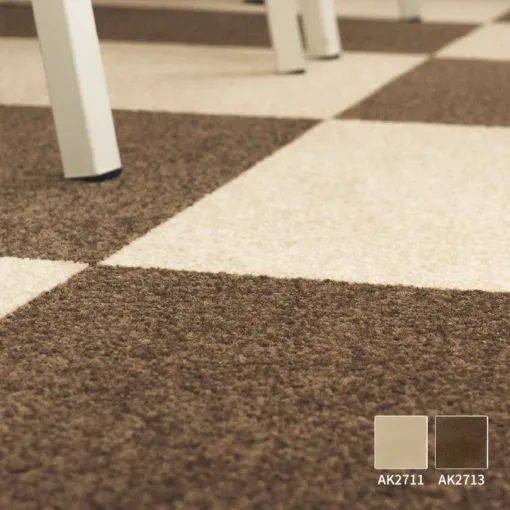
Short answer: TOLI AK27 or AK35 can form a removable dining rug on a compatible finished floor. Cover the full path of each chair, lift rather than drag furniture, and keep spare tiles for washing or replacement. These residential tiles are hand-washable, not machine washable, and their current product pages do not show a caster-chair rating.
Measure the chair pullback zone first
A tabletop measurement is only the center of the calculation. Sit in every chair, stand up, and pull it back to the point where a person can leave normally. Mark the rearmost leg position with tape. Repeat at the table ends, where armchairs or a narrow room can change the distance.
About 60 cm, or 24 inches, beyond each table edge is a useful first tape test, not a universal answer. Deep chairs, arms, accessibility needs, and the way people enter the room may require more. Because AK27 and AK35 are 40 cm modules, round each finished rug side up to the next complete tile rather than creating a narrow cut strip at an exposed edge.
| Check | What to measure | Why it matters |
|---|---|---|
| Tabletop | Maximum length and width, including an extension leaf if normally used | Sets the fixed center of the rug. |
| Chair at the table | Rear-leg position while a person is seated | All legs should rest on one level surface. |
| Chair pulled back | Farthest normal rear-leg position | Prevents a leg repeatedly catching the exposed rug edge. |
| Walking route | Clearance to walls, sideboards, doors, and other chairs | A larger rug must not create a new obstruction. |
| Floor vents and thresholds | Every fixed opening or change in floor height | Keep ventilation and door movement clear. |
AK27 or AK35 for a dining room?
| Feature | AK27 / Attack 270 | AK35 / Attack 350NE |
|---|---|---|
| Tile size | 40 x 40 cm (15.7 x 15.7 in) | 40 x 40 cm (15.7 x 15.7 in) |
| Total thickness | 9 mm | 9.3 mm |
| Pile | 5 mm cut pile | 3-5 mm multi-level loop pile |
| Surface fiber | BCF nylon | Solution-dyed polypropylene |
| Backing | Soft Back Q suction treatment | Soft Back Q suction treatment |
| Dining-relevant treatments shown by TOLI | Stain-resistant and deodorizing | No stain-resistant or deodorizing mark on the current page |
| Lightweight floor-impact class | ΔLL(I)-3 | ΔLL(I)-4 |
| Practical starting point | Meals, pets, colorful borders, and frequent spot care | Quieter neutral rooms where the higher impact class leads |
AK27 is the practical first comparison beneath a family table. Its current TOLI page shows cut pile, stain-resistant treatment, deodorizing treatment, and 14 solid colors. Those marks do not mean stain-proof, waterproof, or maintenance-free. AK35 offers a subdued 16-color palette and the higher published lightweight floor-impact class, but its current page does not show stain-resistant or deodorizing treatment.
Neither current page displays a caster-chair mark. A fixed dining chair with smooth, floor-appropriate glides is not the same load as a wheeled office chair, but dragging any chair can abrade pile, stress seams, or shift a poorly seated edge. Lift chairs when possible, inspect glides for sharp burrs, and use a caster-rated flooring plan if rolling chairs are part of normal use.
Food spills: service one tile, not the whole rug
TOLI's care manual specifically covers common water-based household marks including juice, milk, soy sauce, ketchup, jam, tea, and coffee. The general sequence is prompt removal, water first, diluted neutral detergent when needed, thorough rinsing, and complete shade drying. The manual says not to use a washing machine, spin cycle, or dryer.
- Remove food solids without spreading them.Lift material from the surface before adding moisture.
- Blot a fresh liquid promptly.Use a clean absorbent cloth and work from the outside of the mark inward.
- Lift the affected square.Note its pile direction so it can return to the same orientation.
- Use water, then diluted neutral detergent if needed.Test the method and avoid aggressive scrubbing or unapproved chemicals.
- Rinse away all residue.TOLI warns that incomplete rinsing can reduce suction and make the backing more likely to slip.
- Shade-dry completely.Reinstall only when the tile is fully dry; use a matching spare meanwhile.
Carpet tiles do not stop liquid at a seam. A large spill can reach the base floor, so lift neighboring squares, inspect and dry the finished floor, then reinstall only after both surfaces are clean and dry. Read the full carpet tile cleaning guide before dealing with a difficult mark.
Three dining layouts using complete 40 cm tiles
These examples pair common table sizes with complete modules. They are starting plans, not furniture standards. Tape the full rectangle, move every chair through a real meal routine, and enlarge any side where a leg reaches the boundary.
1. Small four-seat table
5 x 5 / 25 tiles / 200 x 200 cm. About 6 ft 7 in square. Around a 90 x 90 cm table, this leaves approximately 55 cm on each side.
Open the 25-tile layout2. Four- to six-seat rectangle
6 x 5 / 30 tiles / 240 x 200 cm. About 7 ft 10 in x 6 ft 7 in. Around a 140 x 80 cm table, this leaves 50 cm at the ends and 60 cm at the sides.
Open the 30-tile layout3. Six-seat table with generous pullback
8 x 6 / 48 tiles / 320 x 240 cm. About 10 ft 6 in x 7 ft 10 in. Around a 180 x 90 cm table, this leaves 70 cm at the ends and 75 cm at the sides.
Open the 48-tile layoutProtect seams from furniture movement
Clean the compatible finished floor before placement, follow the backing direction, and press every tile flat. Position the table only after the complete rug is seated. Do not use table weight to force a raised corner down. A table leg placed directly across a seam can make future tile removal awkward, so shift the grid or furniture slightly when practical.
Fixed furniture can leave pressure marks in carpet pile. TOLI's manual includes maintenance guidance for furniture dents, but recovery depends on fiber, time, heat, load, and severity. Use broad, smooth, floor-appropriate furniture glides and never assume a mark will disappear completely. Check that any glide does not stain, react with, cut, or snag the carpet.
- Keep all chair legs inside the rug at full pullback.A leg landing beyond the edge creates an uneven transition and repeated catching point.
- Lift ordinary dining chairs.Dragging concentrates force across pile, seams, and exposed edges.
- Inspect seams after gatherings.Re-seat any corner or tile that no longer lies flat before the next use.
- Rotate serviceable tiles if wear becomes uneven.Keep pile direction and the intended pattern consistent when moving squares.
- Separate rolling-load decisions.Choose flooring with an explicit caster claim when wheels are used repeatedly.
Check the base floor before ordering
TOLI lists many finished wood, vinyl tile or sheet, cushion-floor, marble, and ceramic surfaces as compatible examples. Existing carpet, tatami, mortar, and concrete are listed as unsuitable for suction placement. Some wood finishes may not grip reliably, so test a sample first. Also check radiant-heating and flooring-manufacturer restrictions, including possible discoloration beneath long-term floor coverings.
Buying decision: start with AK27 when meals, pets, stains, odor treatment, and replaceable hand-washed squares lead the brief. Compare AK35 when the room needs a quieter palette and its higher published lightweight impact class matters more. Size either product from actual chair travel, not a decorative margin around the tabletop.