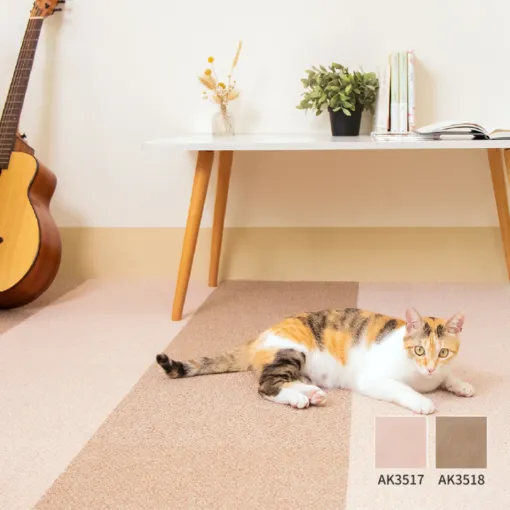
Short answer: TOLI AK35 and AK27 can make a comfortable residential desk rug, especially beneath your feet or a mostly stationary chair. Do not market or treat them as automatically suitable for continuous rolling-chair traffic. They are removable residential Fabric Floor tiles, and TOLI does not give either current product a caster-use claim.
The question is not just “home office or not?”
A home office can contain three very different floor loads. Your feet create ordinary residential traffic. Desk legs and a stationary chair create concentrated static loads. A five-caster chair repeatedly rolls a seated person's weight across a small route and over tile joints. A product can be comfortable for the first job without being specified for the third.
TOLI's own FAQ says Fabric Floor was developed for residential use and is not recommended for non-residential offices on durability grounds. A home office remains a residential room, but the company's general Fabric Floor cautions still matter: local furniture loads may leave indentations, and severe traffic from carts or furniture movement may damage pile or cause lifting.
The distinction is unusually clear because TOLI describes another product, Fabtex Tile, as usable where caster chairs and shopping carts operate. TOLI also directs commercial offices toward its GA and GX carpet tile ranges. That explicit language does not appear on the current AK35 or AK27 pages. TileCarpet.design therefore does not describe AK35 or AK27 as caster-rated.
If the room combines household comfort with repeated rolling loads, compare the product categories before sizing the rug. Our residential vs commercial carpet tile guide explains why the module shape alone does not establish traffic, backing, or caster performance.
Choose the desk zone before the rug size
1. Feet-only zone
2 x 3 / 6 tiles / 80 x 120 cm. Put softness in front of the desk while every caster stays on hard floor. This is the simplest layout for a rolling chair.
Open the 6-tile design2. Stationary chair zone
3 x 4 / 12 tiles / 120 x 160 cm. A compact rug for a fixed chair, stool, or chair that moves only occasionally. Keep the raised edge out of the normal stand-up route.
Open the 12-tile design3. Full work zone
4 x 5 / 20 tiles / 160 x 200 cm. More room does not create a caster rating. Use this size only after tracing the wheel path and confirming how the chosen surface will handle your chair.
Open the 20-tile designExact 40 cm desk-rug sizes
AK35 and AK27 are both 400 x 400 mm, about 15.7 x 15.7 inches. The dimensions below are complete-tile rectangles with no cut perimeter. They are planning footprints, not performance ratings.
| Purpose | Grid | Exact tiles | Metric size | Imperial size |
|---|---|---|---|---|
| Feet only | 2 x 3 | 6 | 80 x 120 cm | 31.5 x 47.2 in / 2.62 x 3.94 ft |
| Compact stationary chair | 3 x 4 | 12 | 120 x 160 cm | 47.2 x 63 in / 3.94 x 5.25 ft |
| Larger residential work zone | 4 x 5 | 20 | 160 x 200 cm | 63 x 78.7 in / 5.25 x 6.56 ft |
| Wide desk or shared zone | 5 x 6 | 30 | 200 x 240 cm | 78.7 x 94.5 in / 6.56 x 7.87 ft |
How to measure a rolling chair path
- Mark the typing position.Place the chair exactly where you work and mark the outside position of all casters with removable tape.
- Roll back to stand.Move far enough to stand normally. This backward point is often more important than the desk width.
- Reach real storage.Roll toward the drawers, printer, or side desk you use. Do not design only around a staged straight-ahead position.
- Trace the outer wheel envelope.Join the farthest caster marks into one rectangle. Include turning, not just forward-and-back movement.
- Round to complete 40 cm rows.Choose the next grid that keeps casters away from an outside edge. A wheel should not repeatedly climb a raised rug boundary.
- Tape-test before ordering.Mark the finished rectangle on the actual floor and use the chair for a normal workday before choosing the tile count.
Keep desk legs and chair wheels away from weak points
When possible, keep the heavy desk legs on the original hard floor and place a complete tile rectangle between or in front of them. If furniture must sit on Fabric Floor, TOLI's guidance says concentrated weight can leave indentations and recommends distributing heavy loads. Use a load-spreading method approved for both the furniture and the flooring rather than resting a narrow metal foot directly on one tile.
Do not place a tile seam directly beneath the chair's most frequent turning point when you can shift the grid. Keep the outside edge away from door swings, stairs, and the route used to enter the chair. TOLI offers edge-finishing accessories for partial layouts, but an edging strip does not turn a residential product into a caster-rated one.
What about a chair mat?
A compatible rigid chair mat may spread wheel movement across a larger area, but “chair mat” is not one universal specification. Confirm that the mat is designed for the carpet's total thickness, remains stable at the proposed size, and has no spikes or backing that will damage the pile. Ask both manufacturers before combining products.
TOLI also warns that some rubber furniture feet and rubber mats can stain or discolor Fabric Floor through direct contact. That means a generic rubber-backed protector should not be added as an untested fix. If compatibility cannot be confirmed, keep the rolling chair on the original suitable hard floor or choose a flooring product explicitly rated for caster traffic.
AK35 vs AK27 at a residential desk
| Feature | AK35 | AK27 |
|---|---|---|
| Current construction | 3-5 mm multi-level loop pile; 9.3 mm total | 5 mm cut pile; 9 mm total |
| Fiber | Solution-dyed polypropylene | BCF nylon |
| Home-office reason to choose | Quiet 16-color palette and textured foot zone | Stain-resistant and deodorizing treatments; cut pile |
| Official impact-sound class | ΔLL(I)-4 | ΔLL(I)-3 |
| Official caster-use claim | Not stated | Not stated |
Impact-sound classes describe a tested floor-impact result; they do not mean a chair becomes silent or effortless to roll. TOLI's Fabric Floor Q&A notes that chair-dragging sound can still be heard. Our apartment impact-sound guide explains the ΔLL(I)-4 and -3 classes and their test limits. Choose AK35 or AK27 for the residential benefits that are actually listed, then solve daily caster traffic as a separate requirement.
Check the base floor before building a desk rug
TOLI lists many wood floors, vinyl tile or sheet, cushion flooring, marble, and ceramic tile as compatible examples. Existing carpet, tatami, mortar, and concrete are listed as unsuitable for the removable suction-backed placement. Some wood finishes may not grip reliably, so TOLI recommends testing with a sample first.
Vacuum dust and grit before placement, let a damp-cleaned floor dry fully, and follow the checker arrow direction specified for AK35 and AK27. Save several tiles from the same order if possible: a desk zone concentrates wear and drink spills, and a matching spare can temporarily fill the space while one tile is hand-washed and dried flat in shade.
Buying decision: choose AK35 or AK27 for a warm feet-only or low-movement residential desk zone. For continuous loaded-caster use, obtain product-specific written confirmation, use a confirmed compatible protection system, or select a commercial carpet tile explicitly rated for that load. A larger rug alone does not solve the specification gap.