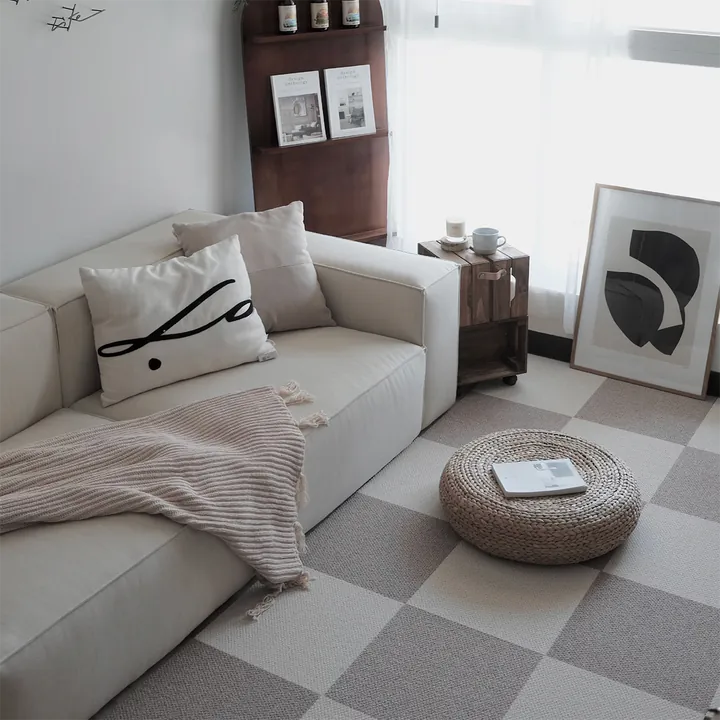
Short answer: use residential carpet tiles when the manufacturer specifies them for household rooms and your floor, traffic, and care needs fit the product. Use commercial carpet tiles for a business, public space, heavy shoe traffic, or repeated rolling load when that exact product is rated for the job. “Commercial” does not automatically mean better at home, and “residential” does not mean suitable for an office.
The square shape does not tell you the use class
A 40 or 50 cm carpet square can be a removable home rug module, a glue-down office finish, or a specialist product built for carts and casters. Those products may look similar in a search result, but the backing, pile, test marks, installation method, and intended traffic can be completely different.
TOLI draws this boundary directly. Its FAQ says Fabric Floor was developed for residential use and is not recommended for non-residential offices on durability grounds. The same answer sends office buyers to the company's GA or GX commercial carpet tile ranges. That is more useful than a generic claim that one category is “stronger”: the manufacturer is assigning different products to different jobs.
Residential vs commercial carpet tiles at a glance
| Buying question | Residential carpet tiles | Commercial carpet tiles |
|---|---|---|
| Primary brief | Household comfort, appearance, localized care, and compatible residential traffic | Specified traffic, workplace or public-space performance, and planned facility maintenance |
| Typical feel | May favor a warmer, thicker, or softer surface | May favor a lower, denser surface that supports frequent traffic |
| Backing and placement | Can include removable suction or non-glue systems, depending on the product | Often uses a manufacturer-specified adhesive system and prepared substrate |
| Rolling loads | Never assume caster suitability unless it is stated | Check the exact traffic and caster claim; “commercial” alone is still not enough |
| Best evidence | Residential-use statement, compatible-floor list, care instructions, and household feature marks | Traffic class, installation specification, test marks, and explicit cart or caster guidance |
| Design priority | Comfort, color, furniture alignment, pets, and a room-scale or rug-scale layout | Wayfinding, replacement plan, traffic lanes, transitions, and facility-wide consistency |
These are selection patterns, not universal rules. The deciding document is always the current data sheet and installation guidance for the exact collection and color you plan to buy.
A documented TOLI example: AK35/AK27 vs GA-100
| Specification | AK35 residential Fabric Floor | AK27 residential Fabric Floor | GA-100 commercial carpet tile |
|---|---|---|---|
| Module | 400 x 400 mm | 400 x 400 mm | 500 x 500 mm |
| Total thickness | 9.3 mm | 9 mm | 6.5 mm |
| Pile | 3-5 mm multi-level loop | 5 mm cut pile | 3.5 mm loop pile |
| Backing | Soft Back Q with suction treatment | Soft Back Q with suction treatment | PVC resin with glass-fiber fabric |
| Placement signal | Residential, removable, no-glue Fabric Floor system | Residential, removable, no-glue Fabric Floor system | Commercial product with a specified installation system |
| Traffic signal | Residential walking mark; no current caster statement | Residential walking mark; no current caster statement | TOLI business traffic class 4 for heavy-traffic areas |
GA-100 is not simply a thinner AK35. TOLI lists BCF nylon, a reinforced PVC backing, JIS L 4406 certification, and its business traffic class 4. The company's description places that class in high-traffic locations such as offices, shops, schools, hospitals, lobbies, corridors, and areas with frequent heavy carts. AK35 and AK27 instead use TOLI's removable Soft Back Q suction treatment and carry household-oriented Fabric Floor features.
Within the residential pair, AK35 and AK27 solve different home needs. AK35 offers a textured loop surface and 16 current colors. AK27 uses cut pile, 14 colors, and TOLI-listed stain-resistant and deodorizing treatments. Neither current product page states that the product is rated for continuous caster-chair use.
When residential carpet tiles are the better fit
Living rooms and bedrooms: start with feel, color, furniture alignment, edge placement, and whether the tile system is approved for the finished floor below. A lower-profile commercial tile may be durable, but durability does not replace the comfort and appearance brief for a barefoot room. For an upstairs apartment, compare the published classes in our carpet tile impact-sound guide without treating them as whole-room soundproofing claims.
Pet and child zones: removable individual modules can make local cleanup and replacement practical. For TOLI Fabric Floor, tiles can be lifted and hand-washed; washing machines and dryers are not allowed. TOLI recommends cut pile for cats and some small dogs whose claws may catch in loops, which is one reason AK27 can be the more suitable pet choice.
Rentals and partial rugs: a no-glue system can avoid permanent adhesive when the base is compatible. TOLI lists many wood, vinyl, cushion-floor, marble, and ceramic surfaces as possible bases, while existing carpet, tatami, mortar, and concrete are listed as unsuitable. Sample-test unfamiliar wood finishes before committing to a room.
When the brief points to commercial carpet tile
A real business or public room: shops, client-facing studios, shared offices, schools, corridors, and entrances should begin with the applicable commercial specification. Do not extend a home-use claim into a workplace simply because the room is small.
Heavy shoes, carts, or repeated rolling: look for an explicit traffic class and product-specific rolling-load guidance. TOLI's Fabtex page, for example, expressly says that product can be used where caster chairs and shopping carts operate. That wording illustrates what a meaningful use claim looks like; it does not transfer to unrelated products.
Large permanent installations: a commercial system may make sense when a prepared substrate, adhesive, transitions, replacement stock, and maintenance plan are all part of the project. This is a flooring installation, not just a larger version of a loose rug.
Can you use commercial carpet tiles at home?
Yes, in some homes, but decide from the data sheet rather than the category label. TOLI's GA-100 gallery includes residential as one of its project filters, which shows that a commercial collection can appear in a home. The proposed base, adhesive, perimeter, door clearance, floor heating, acoustic target, and future removal still need to match the exact product guidance.
Commercial tile may be the sensible answer for a dedicated workroom with an approved rolling-chair specification. It may be the wrong answer for a renter who cannot use adhesive, a bedroom where a softer surface matters, or a finished floor that must remain easy to reveal later. “Can be used” and “best fit” are separate questions.
Five labels to check before buying any carpet square
- Intended setting.Find the manufacturer's residential, commercial, hospitality, education, or other use statement. Do not infer it from photos.
- Traffic and rolling load.Separate ordinary walking, concentrated furniture weight, carts, and caster chairs. Each creates a different stress.
- Backing and installation.Confirm whether the tile uses suction, tabs, peel-and-stick adhesive, pressure-sensitive adhesive, or another specified system.
- Compatible base.Check the actual finished floor, moisture condition, floor heating, and any testing the manufacturer requires.
- Care and replacement.Read the cleaning method, drying method, stain treatment, and spare-tile advice before a spill makes the decision for you.
Room-by-room decision table
| Room or load | Start with | Reason |
|---|---|---|
| Living-room rug zone | Residential | Comfort, color, furniture alignment, removable care |
| Bedroom or bedside zone | Residential | Barefoot feel and a small complete-tile footprint |
| Pet rest or play zone | Residential with the right pile and care features | Local removal, hand washing, and claw-aware pile choice |
| Home desk, feet only | Residential can fit | Keep caster wheels on the approved hard floor |
| Home desk, daily rolling chair | Product explicitly approved for the caster load | A home address does not reduce the repeated rolling stress |
| Shop, clinic, school, or shared office | Commercial specification | Public traffic and facility requirements exceed a residential brief |
| Unfinished concrete basement | Resolve substrate and moisture first | TOLI lists concrete and mortar as unsuitable for Fabric Floor suction placement |
What TileCarpet.design sells
This store sells the residential TOLI AK35 and AK27 collections for homes. We do not relabel them as commercial carpet tiles. Use the 40 cm carpet tile designer for living rooms, bedrooms, pet zones, reading corners, and carefully planned home-office layouts on a compatible finished floor.
For a commercial project, continuous caster route, public entrance, or heavy-cart area, choose a product that the manufacturer explicitly specifies for that exact use. If your requirement sits between categories, send the room, base-floor, traffic, and furniture details before ordering rather than relying on a broad marketing label.
Buying decision: choose the product whose documented use matches the hardest load in the room. AK35 and AK27 are residential Fabric Floor products with removable suction backing. A larger quantity, full-room layout, or home-office address does not turn them into GA/GX commercial carpet tile.