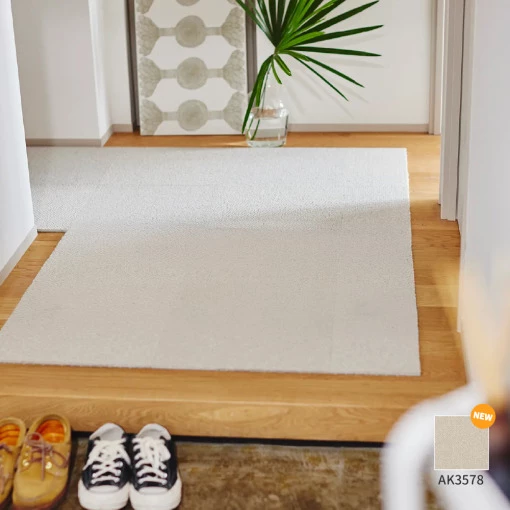
Short answer: for a complete-tile residential rug, calculate baseline spares = the greater of 2 tiles or 10% of installed tiles rounded up. Raise that number to at least the number of important colors in the design, then add one tile for pets, children, dining, entryways, or another higher-mess use. Keep cutting allowance separate.
Free spare-tile calculator
Turn an installed count into an order count
This calculator applies the TileCarpet.design planning rule for a residential AK35 or AK27 rug. It does not calculate wall-to-wall cuts or replace a measured installation plan.
20 installed + 2 spares = 22 total. Keep at least one spare in each of the 2 colors.
Build the installed color gridThree quantities that should not be combined
The phrase "extra tiles" hides three different jobs. Keeping them separate prevents an exact rug from becoming oversized and stops future replacement stock from disappearing into perimeter cuts.
| Quantity | What it covers | When it is used |
|---|---|---|
| Installed count | Every visible square in the finished layout | Immediately, when the rug or floor is placed |
| Cutting allowance | Perimeter cuts, irregular walls, pillars, mistakes, and unusable offcuts | During a cut or wall-to-wall installation |
| Service spares | Wash-day gaps, accidental damage, concentrated wear, and future adjustment | Stored unused until a tile is removed or replaced |
A 4 x 5 rug uses exactly 20 complete tiles. It has zero cutting waste. If you request 22 tiles, the installed rug is still 20 tiles and the other two are service stock. A wall-to-wall room is different: first calculate the cut plan, then add service stock after that installation quantity is settled.
What TOLI actually says about spare tiles
TOLI's current Fabric Floor Q&A tells buyers that keeping several spare pieces is useful for wash-day replacement. Its washing FAQ explains the workflow: lift the dirty tile, put a spare in the opening, hand wash and rinse the removed tile, dry it completely in the shade, then store it for the next rotation.
TOLI does not publish one universal spare percentage for AK35 or AK27. Its current product pages do confirm that both collections use 40 x 40 cm tiles, contain 10 tiles per case, and are listed in Japan as orderable from 10 tiles in one-tile increments with colors mixed. That supports an exact color-by-color spare request instead of rounding every design to another full case.
How the practical rule works
- Fix the installed grid.Use rows x columns for a complete-tile rug. Do not enlarge the rug merely to create spares.
- Calculate the baseline.Multiply installed tiles by 10%, round up, and use two if the result is smaller than two.
- Protect the color plan.Keep at least one spare for each important color code. If that number exceeds the baseline, use the color count.
- Add one for higher-risk use.Pets, children, food, shoes, repeated spills, and a concentrated traffic route justify one more service tile.
- List spares separately.Record the exact spare code and quantity in the invoice request so the installed design remains unchanged.
This is deliberately more specific than saying "buy a few." It also avoids treating 10% as a law. FLOR publicly recommends 10% for its own carpet-tile system because future replacements, adjustments, dye lots, and discontinued styles can matter. That is a useful comparison, not a TOLI specification. Color mix and household use still decide whether the result is sensible.
Recommended spare counts by rug size
| Installed tiles | Standard-use baseline | Higher-risk starting point | Example total |
|---|---|---|---|
| 10-20 | 2 spares | 3 spares | 20 installed becomes 22 or 23 |
| 21-30 | 3 spares | 4 spares | 30 installed becomes 33 or 34 |
| 31-40 | 4 spares | 5 spares | 40 installed becomes 44 or 45 |
| 41-50 | 5 spares | 6 spares | 48 installed becomes 53 or 54 |
| 51-80 | 6-8 spares | 7-9 spares | Use the exact 10% result, then add risk |
The color rule can raise these numbers. A 12-tile pattern using three colors should not have only two spares if preserving every color matters. Conversely, a 30-tile single-color bedroom rug may be well served by three pieces when use is calm and no cutting is involved.
Three exact spare-tile examples
1. Quiet single-color rug
12 installed + 2 Linen spares = 14 tiles. The 10% result is 2 after rounding and the two-tile minimum stays in control.
Open the 12-tile layout2. Two-color border
20 installed + 2 spares = 22 tiles. Keep one AK3578 Linen and one AK3580 Almond so both the field and border remain repairable.
Open the 20-tile layout3. Higher-use family rug
30 installed + 4 spares = 34 tiles. The baseline is three; add one for higher-risk use and split the result two Ivory and two Rice Straw.
Open the 30-tile layoutChoose which colors receive the extra pieces
For a solid rug, every spare uses the same code. For a two-color checker, split an even spare count between the colors. For a border, keep one border tile and one field tile first; place any additional spare in the color that covers more high-use positions. For three or more colors, preserve every color that cannot be substituted without changing the pattern.
Write the complete model code on the order and keep the carton label or invoice record. "Beige" is not enough: AK35 Linen AK3578, AK35 Almond AK3580, and AK27 Sand Gray AK2716 are different products. Current AK35 and AK27 pages each list multiple colors and allow mixed-color ordering, so the spare mix can follow the design rather than a generic neutral.
Store and rotate spare tiles deliberately
Store every spare clean, completely dry, and flat, with the model code and order date attached. Do not treat the spare as leftover packaging material. TOLI warns that a washed tile must dry fully before it returns to the floor, and its FAQ suggests keeping the removed tile for the next rotation after washing.
A stored replacement can initially look newer than installed flooring. Interface's maintenance guide makes that general carpet-tile point explicitly and suggests moving a visibly newer tile to a less conspicuous area when necessary. With a modular rug, you can rotate the clean spare into a sofa edge, under a light table, or another lower-visibility position while the original tile returns to service.
When this rule is not enough
Do not use the calculator as a wall-to-wall cutting allowance. Angled walls, alcoves, pillars, centered layouts, door recesses, unusable offcuts, and installer technique can change the required quantity. Build the measured installation count first, then add service spares with the rule above.
Also separate shipping damage or incorrect goods from planned spares. Inspect cartons and color codes promptly. A service spare is an intentionally unused tile for future care; it is not a substitute for reporting a missing, wrong, or transit-damaged item under the order terms.
Buying decision: request 2 spares for most 10-20 tile rugs, 3 for 21-30, 4 for 31-40, and 5 for 41-50. Add one in pet, child, dining, or entry zones. If the design uses more colors than that baseline, keep at least one of each important code.